Social CRM: 5 Signs Your Business Needs
5 Signs Your Business Needs a Social CRM Platform
Managing customer messages across LINE, Instagram, WhatsApp, and Messenger can feel like chaos. If your team is overwhelmed, missing messages, or losing sales due to slow responses, it’s time to rethink your approach. A Social CRM platform simplifies everything by bringing all conversations into one place, automating repetitive tasks, and helping your team respond faster and more consistently.
Here are the 5 signs your business could benefit from a Social CRM platform:
- Too many messages across platforms: Switching between apps wastes time and leads to missed messages.
- Slow responses: Customers expect replies within minutes, not hours.
- Inconsistent service quality: Mixed responses across platforms confuse customers.
- No performance insights: Without data, tracking team efficiency is impossible.
- Manual work overload: Repetitive tasks slow down growth and burn out your team.
The solution? Tools like ReplyAll Chat centralize messages, automate FAQs, and track performance, helping businesses save time, reduce errors, and improve customer satisfaction.
Top 5 Reasons to Integrate Your CRM with Social Media
1. Too Many Customer Messages Across Different Social Platforms
Managing customer conversations across platforms like LINE, Instagram, WhatsApp, and Messenger can quickly become overwhelming. Switching between apps wastes time, increases the chance of missing messages, and makes it tough to keep track of conversations. The situation gets even trickier when customers jump between platforms - browsing products on Instagram, asking questions on LINE, and finalizing purchases on WhatsApp. Without a centralized system, your team risks losing context, leading to repeated questions and frustrated customers.
This isn’t just a hypothetical problem - real businesses have faced it.
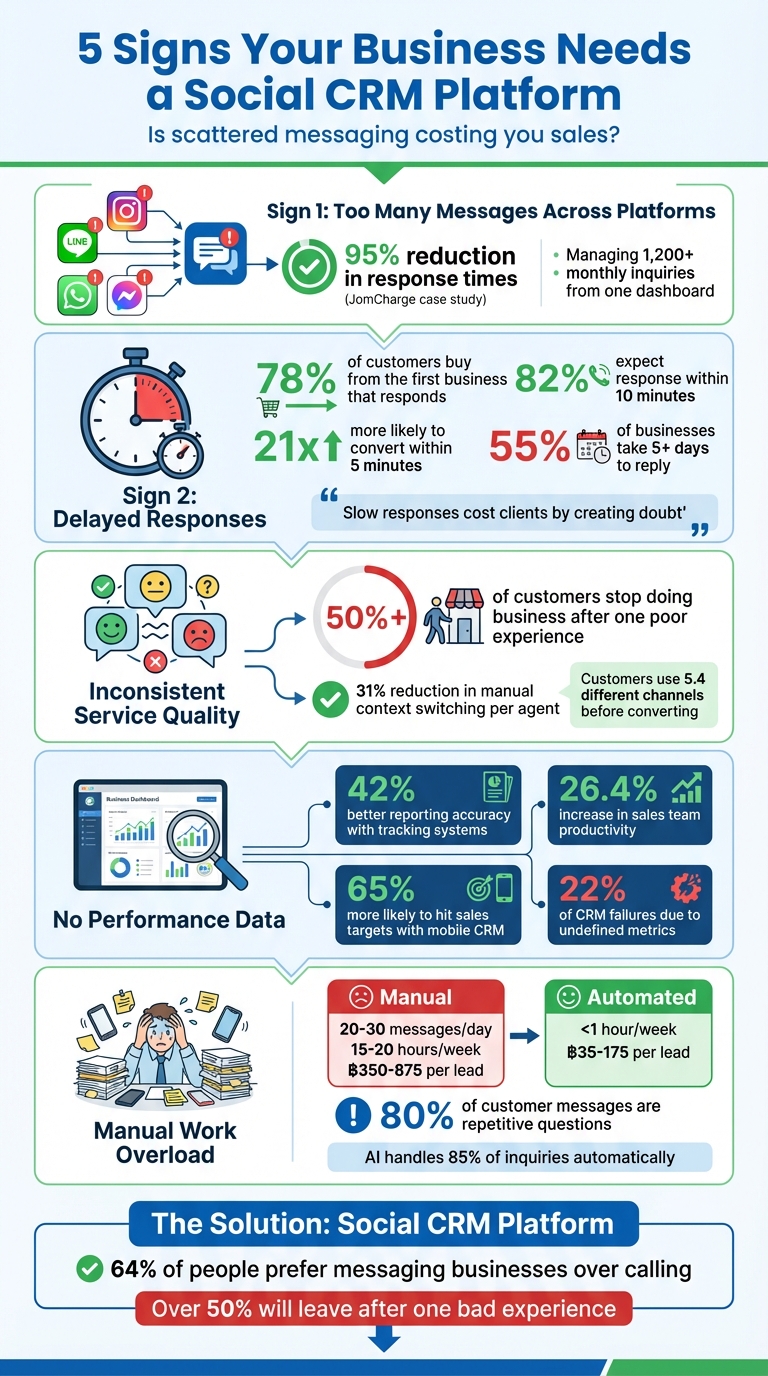
Take JomCharge, a Malaysian EV charging provider, as an example. Back in March 2026, they struggled with a surge in inquiries from EV drivers needing immediate support. WhatsApp Web’s login limitations made it hard for agents to collaborate effectively. By adopting a unified inbox to manage over 1,200 monthly inquiries, they slashed response times by 95% and doubled their resolution speed.
Fragmented communication isn’t just inefficient - it’s a poor experience for your customers. A Social CRM platform solves this by consolidating all your social channels into one easy-to-use dashboard. Your team can manage multiple conversations at once without losing the thread, ensuring every interaction feels seamless and connected.
2. Delayed Responses Causing Missed Sales
Speed matters when it comes to converting leads. When a customer messages your business on LINE, Instagram, WhatsApp, or Messenger, they’re often ready to make a purchase - they just need a small detail clarified. Here’s the kicker: 78% of customers end up buying from the first business that responds. If you’re slow to reply, chances are, they’ve already moved on to a competitor who got back to them faster.
The numbers don’t lie. Responding within 5 minutes makes you 21 times more likely to convert a lead, whereas delays can slash your chances by 80%. And here’s what customers expect: 82% want a response within 10 minutes, but shockingly, 55% of businesses take more than five days to reply. That’s a huge gap between expectations and reality.
“Slow responses cost clients by creating doubt.” - Jonny Rowse, CRM Beat
A unified platform can help close this gap by streamlining response times across all channels. Customers compare options quickly and make decisions just as fast. A delayed reply doesn’t just cost one sale - it can damage trust with your existing customers. Every unanswered message sends a signal that you might be disorganized or, worse, indifferent.
The solution isn’t about hiring more staff - it’s about equipping your team with the right tools. Automated acknowledgements can immediately reassure customers that their message was received. Smart routing ensures inquiries land in the right hands without delay. Meanwhile, AI-powered chatbots can tackle repetitive questions like “What’s the price?” or “What are your business hours?” 24/7, leaving your team free to focus on closing deals.
3. Different Quality of Responses on LINE, Instagram, WhatsApp, and Messenger
Inconsistent responses across platforms can frustrate customers and damage trust. One agent might provide detailed replies on LINE, while another rushes through Instagram DMs with brief answers. WhatsApp might see a mix of tones, leaving customers confused. This lack of uniformity doesn’t go unnoticed - over 50% of customers will stop doing business with a brand after just one poor service experience.
The main issue? Context gets lost when your team juggles multiple apps. For instance, a customer might inquire about pricing on LINE, then follow up on Instagram, only to receive redundant or mismatched responses. This wastes time, frustrates customers, and makes it nearly impossible to enforce quality standards or track accountability. A centralized system can solve this. By reducing manual context switching by 31% per agent, it minimizes confusion and ensures smoother, more consistent service. These aren’t just hypothetical problems - they directly impact customer satisfaction.
Inconsistent answers also weaken customer trust. Take JomCharge, for example. Before centralizing their system, they struggled to manage high volumes of inquiries, leading to uneven service. After implementing a unified inbox with automated acknowledgements, they cut average response times by 95%, doubled resolution speed, and improved customer satisfaction scores significantly.
A centralized platform offers agents access to complete customer history, standardized templates, and AI tools for consistent support. With these resources, your team can deliver uniform responses across all channels, handle routine questions efficiently, and maintain quality 24/7. Considering customers interact across an average of 5.4 different channels before converting, treating each platform as a silo is no longer an option. A unified approach ensures a seamless, trustworthy customer experience.
4. No Clear Data on Team Performance or Customer Activity
Tracking team performance and customer activity is just as important as consolidating conversations. While merging messages into one platform is helpful, it’s the insights into your team’s efficiency and customer interactions that truly drive growth.
When you don’t have clear performance metrics, managing your team becomes a guessing game. You won’t know who’s responding quickly, who’s closing deals, or where customers are falling through the cracks. Research shows that businesses with proper tracking systems see 42% better reporting accuracy, and sales team productivity increases by 26.4% when social media features are integrated into CRM tools. On the flip side, 22% of CRM implementation challenges stem from issues like poor user adoption and undefined success metrics. Companies using mobile CRM tools are 65% more likely to hit their sales targets, and those that focus on engagement and tracking data often see lower operational costs and improved sales performance.
Without centralized data, you’re left with blind spots. Social signals - like Instagram comments or LINE messages - can go unnoticed, leading your team to miss out on high-intent leads. You also lose the ability to identify bottlenecks in the customer journey or pinpoint where prospects are dropping off. Low visibility into how systems are being used wastes resources and stifles innovation. Without a clear picture of your metrics, sales forecasts become unreliable, and spotting key business trends becomes nearly impossible.
Modern platforms address these issues with real-time dashboards that provide actionable insights. You can monitor each agent’s conversation volume, response time, and pinpoint where deals are stalling in the pipeline. Tracking metrics like response times and resolution rates allows you to hold your team accountable and identify who might need additional training. This level of visibility replaces guesswork with data-driven decisions, helping you allocate resources effectively and focus on strategies that yield results. These insights not only sharpen sales forecasts but also integrate seamlessly into platforms designed to consolidate performance data.
5. Manual Work Slowing Down Business Growth
Relying on manual message handling can seriously hold your business back. If your team spends hours copying and pasting the same responses every day, you’re not just wasting time - you’re also capping your potential to scale. On average, manual outreach tops out at around 20–30 messages per day. Beyond that, burnout sets in, and scaling becomes impossible without hiring more staff. Think about it: manual processes eat up 15–20 hours a week, while automation can shrink that to less than an hour.
The financial difference is just as striking. Manual processes can cost you anywhere from ฿350 to ฿875 per qualified lead. In contrast, automated systems bring those costs down to just ฿35–฿175 per lead. Automation doesn’t just save time - it ensures consistency, even during your busiest periods.
When things get hectic, manual outreach often grinds to a halt as your team prioritizes existing client needs. This stalls your sales pipeline and costs you valuable opportunities. On top of that, repetitive tasks eat up 3–5 hours of high-value work daily, leading to inconsistent responses, missed follow-ups, and delays that can harm your reputation.
Switching between multiple apps only adds to the inefficiency. Constantly toggling between tools disrupts focus and lowers productivity. Without automated tracking, you lose the ability to A/B test message strategies or pinpoint which channels deliver the best ROI. Meanwhile, your competitors are using data to fine-tune every interaction.
But automation isn’t about replacing your team - it’s about helping them work smarter. Around 80% of customer messages are repetitive questions about links, pricing, or bookings. Automation can handle these instantly, giving your team the freedom to focus on the remaining 20% of conversations where their expertise and relationship-building skills truly shine.
This is where ReplyAll Chat steps in, streamlining customer engagement across all your channels.
How ReplyAll Chat Solves These Problems
ReplyAll Chat addresses the challenges of managing customer conversations across various social channels by offering a single, unified platform. Instead of managing multiple LINE channels or inboxes separately, businesses can manage all messages from one centralized inbox. This setup allows team members to handle multiple conversations - up to 3–4 at a time - leading to quicker responses and fewer missed opportunities. By consolidating communication, the platform also enables the use of advanced AI tools to streamline operations.
To combat message fragmentation, ReplyAll Chat provides two modes. Autopilot handles routine queries - like pricing or booking confirmations - automatically, while Copilot allows agents to fine-tune AI-generated responses for a more personalized touch. The AI also analyzes customer intent and sentiment in real time, flagging urgent or frustrated messages so they can be prioritized.
For businesses worried about inconsistent service, the platform’s multi-agent collaboration feature ensures continuity. Agents have access to the full conversation history, even when customers switch between platforms. This means customers never have to repeat themselves, making interactions more seamless and personal.
The platform also includes an analytics dashboard that tracks key metrics like response times, resolution rates, and enquiry volumes. This helps identify engagement trends and links conversations to revenue. With automated workflows and real-time alerts, businesses can reduce average response times by up to 95%, while AI handles as much as 85% of customer enquiries automatically. These insights translate into tangible improvements in customer interactions.
In March 2026, Malaysian EV company JomCharge demonstrated the platform’s effectiveness. Using ReplyAll Chat’s unified inbox, they managed over 1,200 monthly enquiries, slashed response times by 95%, and doubled resolution speed. This resulted in higher customer satisfaction ratings. This success story highlights how a unified platform not only resolves inefficiencies but also frees teams to focus on conversations that require a human touch.
ReplyAll Chat Plans Comparison
ReplyAll Chat provides flexible pricing options designed to meet the needs of businesses of all sizes and activity levels.
There are three tiers to choose from. The Starter plan, priced at ฿17,465 per month, is ideal for small teams handling up to 2,000 monthly active contacts. It includes unlimited messaging, unlimited team members, and priority support. This plan works well for businesses starting to streamline customer service across platforms like LINE, Instagram, WhatsApp, and Messenger.
Next up is the Growth plan, which costs ฿34,965 per month and supports up to 10,000 monthly active contacts. It builds on the Starter plan by adding features like custom dashboards, connection requests, and the ability to submit feature requests. This plan is particularly popular among Thai businesses growing rapidly on LINE, the country’s most widely used messaging app.
For larger organisations managing more than 10,000 monthly active contacts, the Enterprise plan offers tailored pricing with volume discounts. This tier provides advanced options like custom integrations, SLA guarantees, onboarding support, and self-hosting advice. It’s designed for businesses needing specialised workflows or compliance solutions.
All plans come with unlimited messaging and team members, ensuring no unexpected costs. Pricing is based on the number of monthly active contacts - customers who actually engage with your business - so you only pay for real interactions.
Conclusion
Are you finding it tough to manage scattered messages across LINE, Instagram, WhatsApp, and Messenger? Struggling with slow response times, inconsistent service, or manual processes that slow your growth? These issues could be holding your business back.
Here’s the reality: over 50% of consumers will stop doing business with a brand after just one bad service experience. And with 64% of people preferring to message businesses on social media instead of calling, every unanswered message is a missed chance to boost your sales.
ReplyAll Chat tackles these pain points head-on. It pulls all your social conversations into one easy-to-use dashboard, provides smart reply suggestions, and gives you clear metrics on response times and team performance. Automated message routing ensures no inquiry is overlooked, while AI takes care of repetitive FAQs, freeing your team to focus on closing deals. Whether you’re managing 2,000 active contacts or tens of thousands, ReplyAll Chat grows with your business. Plus, its pricing is straightforward - you only pay for customers who actively engage, with no extra fees for unlimited messages or team members.
As Thai businesses continue to embrace conversational commerce, the right tools can help you stay ahead. ReplyAll Chat transforms social media struggles into new opportunities for growth.
FAQs
What is a Social CRM platform?
A Social CRM platform combines the power of social media with traditional customer relationship management (CRM) tools. It allows businesses to manage customer data and interactions across platforms such as Facebook and Instagram. What sets it apart from traditional CRMs is its ability to track social profiles, capture leads directly from social media, and speed up response times. This makes it an invaluable tool for managing the increasing volume of digital interactions and fostering stronger relationships with customers.
How fast should we reply to DMs to avoid losing sales?
To keep sales on track, aim to respond to DMs within 5 minutes. Quick replies can dramatically improve conversion rates. Although 35% of users anticipate a response within an hour, getting back to them even faster not only enhances customer satisfaction but also increases the likelihood of turning inquiries into sales. Speedy responses in DMs can be the game-changer for holding onto potential leads and converting them effectively.
Which metrics should I track to improve team performance?
Tracking the right metrics is essential for improving team performance in a Social CRM platform. Start by focusing on response times, customer satisfaction levels, and engagement rates. These indicators give you a clear picture of how efficiently your team interacts with customers and the quality of those interactions.
It’s also important to keep an eye on lead conversion rates and the volume of social interactions. These metrics help you understand how well your team is turning engagement into tangible results, like new customers or sales opportunities.
Using AI tools can take your tracking to the next level. For example, AI can help measure chatbot accuracy - are your bots providing the right answers? - and assess lead qualification success. With these insights, you can fine-tune workflows, eliminate bottlenecks, and ensure your team operates smoothly in a fast-paced, social media-driven environment.