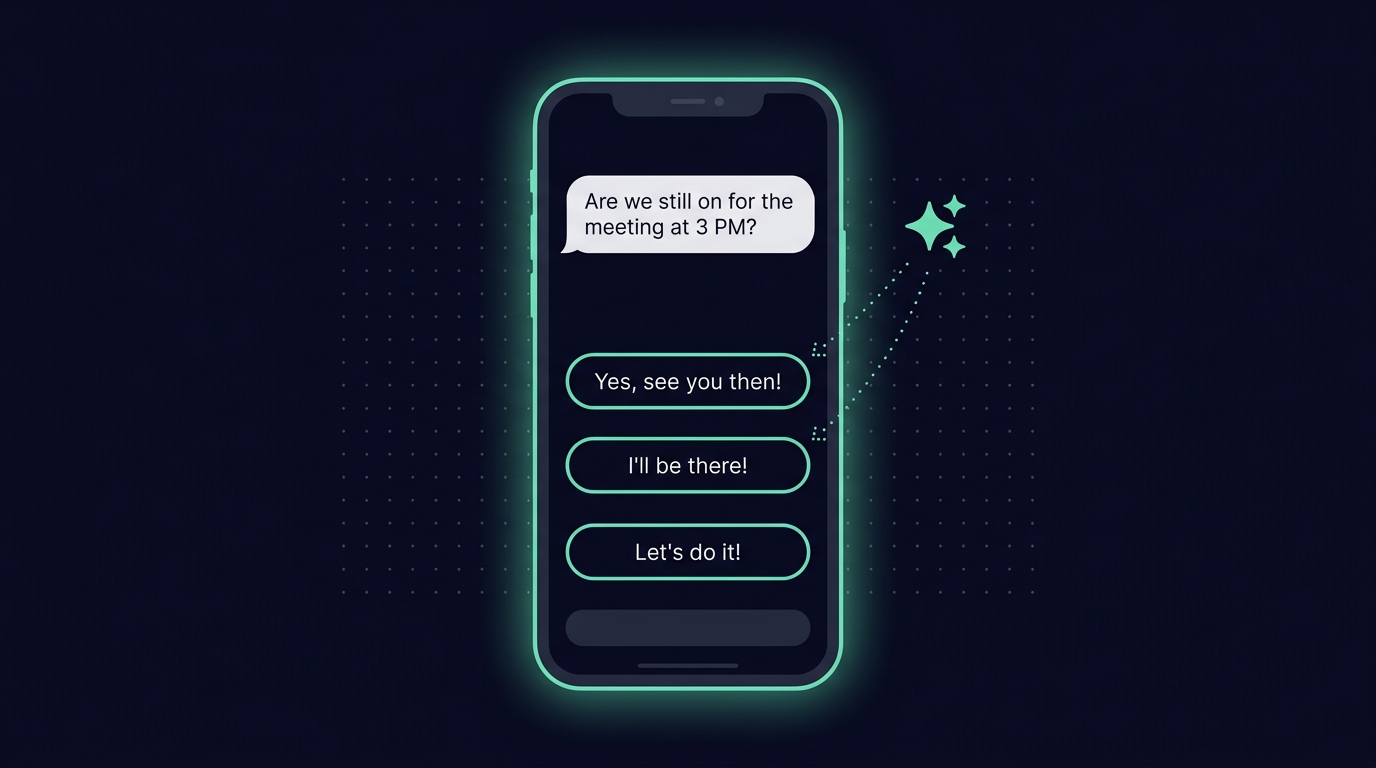
Smart Reply Features: How They Work
How Do Smart Reply Features Work? Common Questions
Smart reply features use AI to help businesses respond to customer messages faster and more efficiently. Here’s how they work:
- Analyze Messages: AI processes incoming messages, understanding intent and context by reviewing up to 10 previous messages in a conversation.
- Generate Suggestions: The system provides up to 3 response options that align with the business’s tone and style.
- Learn and Improve: Over time, the AI adapts based on which suggestions are used, edited, or rejected, ensuring better alignment with the brand.
- Integrate with Data: It pulls information from FAQs, knowledge bases, and business records to provide accurate responses, such as pricing in ฿ or delivery times.
These tools save time, reduce the need for additional staff, and ensure quick, accurate replies - key for businesses in Thailand managing high message volumes on platforms like LINE, Instagram, and WhatsApp.
How Smart Reply Features Work
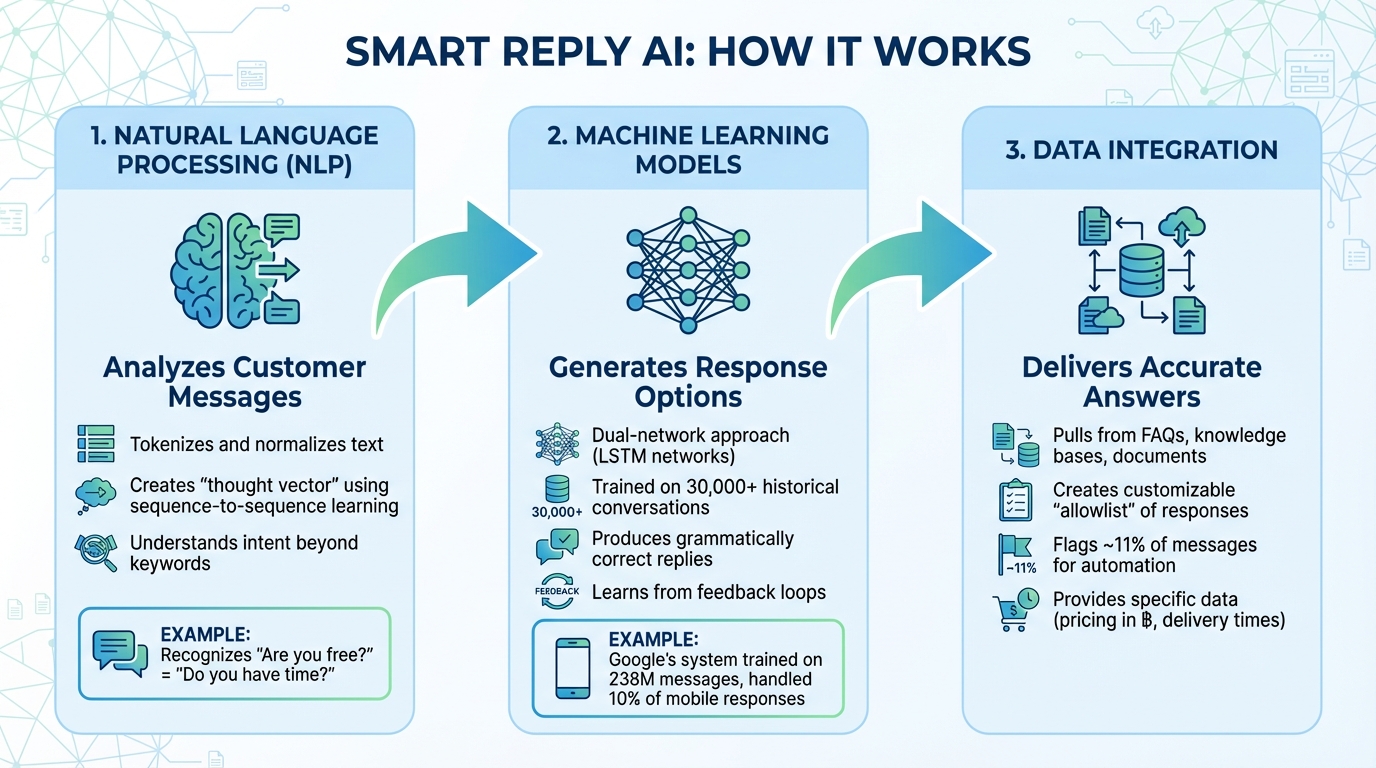
Handling high volumes of customer messages can be daunting, but smart reply technology makes it manageable. By combining natural language processing (NLP), machine learning, and data integration, these systems deliver quick, context-aware responses. Here’s how the core components work together: NLP deciphers customer intent, machine learning predicts suitable replies, and business data ensures the responses are accurate and relevant.
Natural Language Processing (NLP)
NLP enables smart reply systems to comprehend messages beyond surface-level keywords. It uses sequence-to-sequence learning, treating conversations like translation tasks. When a message comes in, an encoding network - often a recurrent neural network - analyzes the words sequentially to create a “thought vector.” This numerical representation captures the essence of the message.
“The encoding network consumes the words of the incoming email one at a time, and produces a vector… This vector captures the gist of what is being said without getting hung up on diction.” - Greg Corrado, Senior Research Analyst, Google
For instance, phrases like “Are you free?” and “Do you have time?” are recognized as having the same intent, even with different wording. Before processing, the system cleans the text by tokenizing and normalizing, filtering out unnecessary details. To keep suggestions varied, responses are mapped to different semantic intents, offering options like positive, neutral, and negative tones.
Machine Learning Models
Once NLP creates the thought vector, machine learning steps in to generate responses. This involves a dual-network approach: the first network captures intent, while the second produces a grammatically correct reply. Long Short-Term Memory (LSTM) networks, a type of recurrent neural network, are often used to retain the context of the conversation over time.
These systems improve through feedback loops. For example, in 2016, Google researchers like Anjuli Kannan and Sujith Ravi developed a large-scale Smart Reply system for Inbox by Gmail. Trained on 238 million messages, it managed 10% of mobile responses for the app. For businesses, training typically requires at least 30,000 historical conversations. Performance is measured by “recall”, which shows the percentage of agent messages that match the top three suggestions provided by the model.
Integration with Data Sources
To deliver accurate responses, smart reply systems tap into your business’s existing knowledge. They train on historical conversation datasets to learn industry-specific language and response styles. This process generates an “allowlist” of responses, which can be reviewed and customized before going live.
The system also integrates with internal knowledge bases, FAQs, and documents to ground its suggestions in reliable information. For example, if a customer asks about pricing in ฿ or delivery times, the system pulls data directly from your records rather than making assumptions. A triggering module ensures that only about 11% of incoming messages are flagged for automated responses, leaving more complex issues for human agents. This setup allows smart replies to handle routine tasks like scheduling, freeing up your team to focus on more critical customer interactions.
ReplyAll Chat’s Smart Reply Workflow

ReplyAll Chat uses a three-step process to handle customer conversations, blending AI technology with human oversight. This workflow starts by analyzing incoming messages, moves on to generating suggestions that reflect your brand’s tone, and concludes with your team fine-tuning responses before sending them. This method balances efficiency with quality and appropriateness.
Analyzing the Conversation Context
When a customer message comes in, ReplyAll Chat reviews up to 10 of the most recent messages in the conversation thread. It also uses brand profiling to understand your business better by analyzing your LINE conversation history and communication patterns. This helps identify your brand’s category and natural communication style. The system can even learn from your existing LINE customer interactions, detecting frequently asked questions and their answers to eliminate the need for manual setup.
Beyond understanding the broader context, the system dives into each message’s specific details. It evaluates keywords, intent, and emotional tone while factoring in your business’s unique context. For instance, it can tell the difference between a casual question about stock availability and a time-sensitive complaint about a delayed order, ensuring the AI’s suggestions are tailored to the situation.
Generating On-Brand Suggestions
Once the context is clear, ReplyAll Chat generates up to 3 suggestions. These suggestions are informed by your uploaded FAQs, configured tone, and patterns from past conversations.
You can define your brand voice by choosing from preset styles like formal, casual, empathetic, or humorous. The platform also supports negative constraints, letting you specify what to avoid - like overly casual language or particular filler words that don’t match your brand. This ensures every suggestion feels aligned with your brand identity.
“A hybrid approach, where AI and human agents work in tandem, is the most effective strategy for delivering exceptional customer experiences.” - Kathy Ross, Senior Director Analyst, Gartner
The system stays up-to-date by adapting its suggestions as you publish new content or update your product offerings. For businesses handling multilingual communication, ReplyAll Chat automatically detects the language of each conversation, tailoring suggestions to match the customer’s preferred language and communication style.
Customizing and Sending Responses
After generating suggestions, ReplyAll Chat allows your team to refine and finalize responses. AI-generated suggestions serve as drafts that agents can edit directly in the messaging input field before sending. If the initial suggestions don’t feel suitable, agents can click “Regenerate Response” to get a fresh set of options.
For situations requiring a specific tone - like addressing a sensitive issue - the platform offers a Rephrase feature. This tool lets agents adjust the tone of a suggestion, making it more formal, concise, or friendly depending on the situation. This ensures your team can maintain a personal touch while benefiting from the speed and efficiency of automation.
Benefits of Smart Reply Features for Businesses in Thailand
Smart reply technology offers practical solutions to challenges faced by businesses in Thailand, helping them save time, scale operations, and cater to local market needs.
Efficiency and Time Savings
Smart reply features speed up response times by providing pre-drafted, brand-aligned replies with a single click. By pulling information directly from your knowledge base - like your website, FAQs, PDFs, or stored snippets - it ensures responses are always accurate and current.
This efficiency becomes especially valuable in high-volume situations. For instance, in early 2026, iMotorbike used AI to handle 70% of customer chats, which doubled their leads while reducing response times by 67%. Routine inquiries, such as stock availability or pricing, are managed by AI, freeing up human agents to focus on complex tasks like negotiations or customer concerns.
Scalability Without Expanding Teams
With smart reply tools, businesses can handle a growing number of conversations without increasing headcount. Operating 24/7, the AI ensures quick responses, meeting the 10-minute standard expected by 90% of customers. It can also qualify leads by asking relevant questions and updating customer information in real time, allowing sales teams to focus on high-value prospects.
Between February and April 2024, GETUTOR, an education consultancy, automated course bookings and lead qualification using AI. This resulted in a 24% sales increase and a 50% rise in daily leads, all without hiring additional staff. Similarly, Automax, a luxury car dealership, managed over 80,000 WhatsApp messages monthly, effectively qualifying buyers and achieving a 42.5x return on investment. The technology also tailors communication to fit local market preferences.
Localized Relevance for Thai Markets
ReplyAll Chat is designed to handle Thai-English conversations seamlessly on LINE Official Account. It can even transcribe voice notes and process images or PDFs, aligning with the diverse communication styles prevalent in Thai social commerce.
For businesses in Thailand, tracking ROI is simplified with analytics presented in familiar formats. Metrics are displayed using local number conventions, and cost savings are shown in THB, making it easier to assess performance in terms that align with local business practices. This localized approach ensures that the system not only improves efficiency but also resonates with the unique needs of Thai businesses.
Conclusion and Key Takeaways
Smart reply features are transforming how businesses handle customer interactions by combining AI with your company’s specific knowledge base. Tools like ReplyAll Chat use your website, FAQs, and internal documents to generate responses that are accurate and consistent with your brand’s voice. This system is designed to handle Thai–English conversations effortlessly on LINE. It even processes voice notes and images - key elements in Thai social commerce.
With advanced natural language processing (NLP) and machine learning models, automated replies remain precise and aligned with your brand. For businesses in Thailand, this technology can automate up to 80% of repetitive inquiries and increase sales by 24% within just two months. Operating around the clock, the AI ensures no potential leads slip through the cracks, all without needing extra staff. Companies using this technology have reported doubling their leads and cutting response times significantly.
However, automation works best when paired with human oversight. As Rocket Agents puts it:
“AI handles the first draft; humans review, adjust, and send”
This collaborative approach ensures high-quality responses every time. To keep the system sharp, regular updates to your knowledge base and feedback on AI suggestions are essential for maintaining alignment with your brand voice.
ReplyAll Chat also stands out by tailoring its features to local needs. From presenting analytics in familiar formats to showing costs in Thai Baht and addressing Thai language intricacies, it helps businesses in Thailand track ROI and refine their customer engagement strategies. The combination of AI efficiency and human input allows businesses to connect with customers effectively and genuinely.