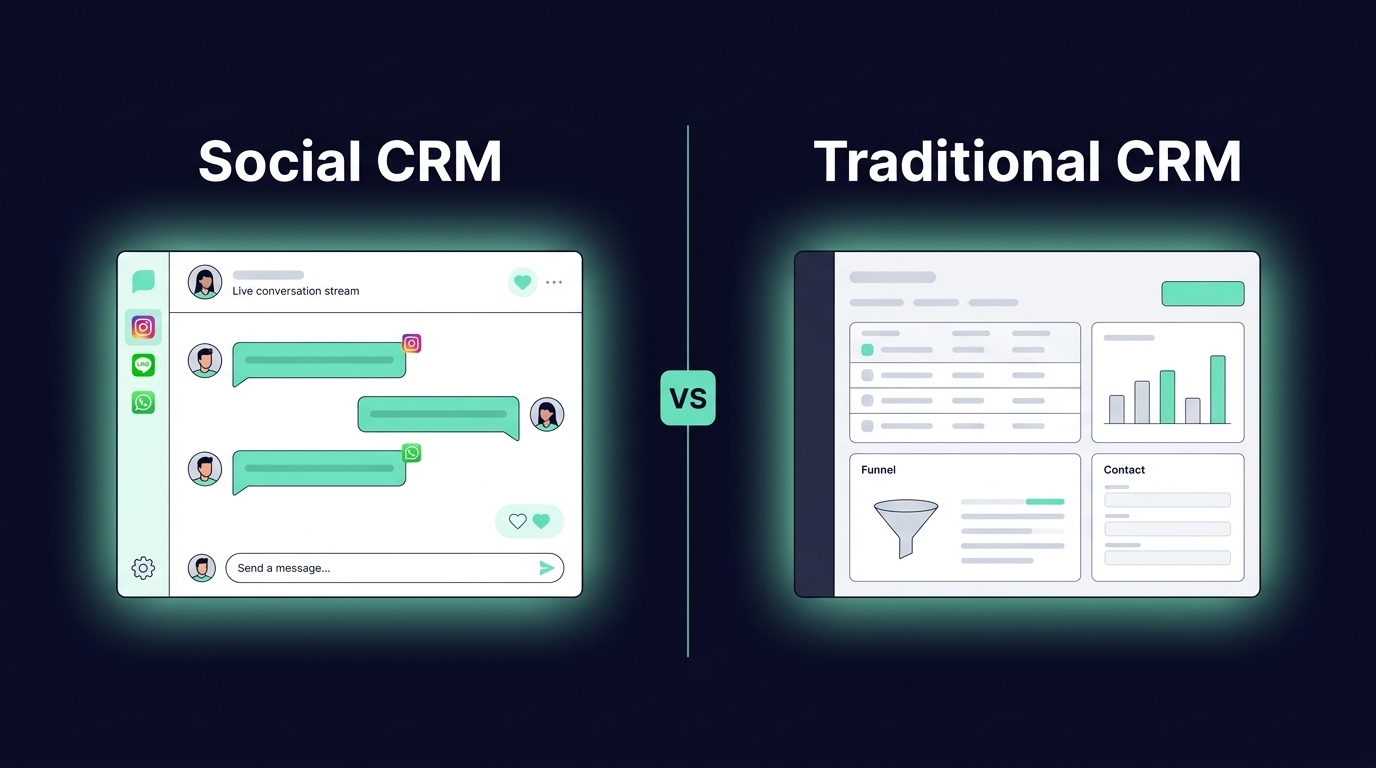
Social CRM vs Traditional CRM Guide
Social CRM vs Traditional CRM: Key Differences
Social CRM and Traditional CRM serve different purposes in managing customer relationships. Here’s a quick breakdown:
- Traditional CRM focuses on structured data like emails, phone calls, and purchase histories. It works best for industries with long sales cycles (e.g., real estate, insurance) and relies on formal communication methods like email and phone. However, it struggles with real-time interactions.
- Social CRM integrates social media platforms like LINE, Instagram, and WhatsApp, enabling real-time responses and gathering unstructured data (e.g., comments, messages, and sentiment). It’s ideal for fast-paced environments and markets like Thailand, where platforms like LINE dominate with 50 million active users.
Key Differences:
- Channels: Traditional CRM uses email and phone; Social CRM uses social platforms.
- Data: Traditional CRM handles structured data; Social CRM combines structured and unstructured data.
- Response Time: Traditional CRM is slower (hours to days); Social CRM is faster (real-time).
- AI Tools: Social CRM includes AI features like sentiment analysis and automated responses, while Traditional CRM focuses on basic automation.
Quick Comparison:
| Feature | Traditional CRM | Social CRM |
|---|---|---|
| Primary Channels | Email, Phone | LINE, Instagram, WhatsApp |
| Data Type | Structured | Structured + Unstructured |
| Response Speed | Hours to Days | Real-Time |
| AI Features | Basic Automation | Sentiment Analysis, AI Chatbots |
In Thailand’s social-first market, combining both systems can maximize efficiency. Use Social CRM for instant engagement and Traditional CRM for structured data management.
What is Traditional CRM?
Traditional CRM is essentially a system designed to manage customer data using structured databases and scheduled workflows. Think of it as a digital hub where businesses store information like purchase histories, contact details, and past interactions. This creates a “single source of truth”, ensuring that sales, marketing, and customer service teams can access consistent, up-to-date information.
“CRM is about discipline. It is about ensuring that relationships are not left to memory, chance, or individual heroics.” – Atul Gupta, CloudVandana
The communication style in traditional CRM is mostly one-way: businesses reach out to customers through targeted emails, scheduled calls, or support tickets. Customers, on the other hand, have limited opportunities to respond in real time.
Sales teams play a key role in maintaining these systems, manually inputting meeting notes, updating deal stages, and recording phone conversations. When used effectively, traditional CRM can lead to impressive results, such as a 30% boost in customer retention and 25% faster sales cycles. However, these benefits rely heavily on having accurate, consistently updated data.
Core Features of Traditional CRM
Traditional CRM systems are built around several essential tools that help businesses manage customer relationships more systematically:
- Contact Management: This feature centralizes customer details - like names, phone numbers, emails, and interaction histories - into a shared database. It ensures every team member has the context needed for meaningful customer interactions.
- Sales Force Automation: Tracks leads as they progress through the sales pipeline, automating tasks like follow-up reminders and deal updates.
- Marketing Automation: Handles email campaigns and customer segmentation, enabling businesses to deliver timely and personalized messages.
- Customer Service & Support: Manages support tickets and tracks issues from submission to resolution, ensuring no customer concern slips through the cracks.
- Analytics & Reporting: Turns raw data into actionable insights via dashboards, often enhanced by AI tools.
While this framework is effective for managing longer sales processes, it often struggles to keep up with the demands of real-time, fast-moving customer interactions.
How Traditional CRM Works in Real Situations
Traditional CRM shines in industries where sales cycles are lengthy and involve multiple stakeholders. For example, sectors like aerospace, mining, manufacturing, real estate, and insurance rely heavily on these systems. These businesses often deal with complex client relationships, multi-stage approval processes, and extended timelines, making traditional CRM’s structured workflows a natural fit.
However, the system isn’t as effective in faster-paced environments. In Thailand, for instance, customers expect quick responses on platforms like LINE or Instagram. Traditional CRM’s reliance on structured workflows and manual data entry can lead to delays. Addressing customer complaints through emails or phone calls may take days - or even weeks.
This gap highlights the need for solutions tailored to real-time interactions, which is where Social CRM steps in.
What is Social CRM?
Social CRM connects social media platforms like LINE, WhatsApp, Facebook, and Instagram with traditional CRM tools, enabling businesses to manage customer interactions in real time. Unlike older systems that focus on structured data and scheduled workflows, Social CRM gathers customer interactions - such as tweets, comments, or direct messages - to create a detailed view of customer behavior and sentiment. This approach shifts the focus from cold calls and hard selling to real-time, customer-driven conversations.
“Whereas a traditional CRM is a passive record keeper, social CRM is an active engagement engine.” – Jennifer Taylor, Product Demand Generation Specialist, Lark
In Thailand, where prompt responses are crucial, Social CRM addresses the limitations of traditional systems. By merging structured data (like purchase history) with unstructured data (like social media interactions), it identifies real-time customer intent. This allows businesses to respond immediately, avoiding delays typical of email or ticket-based resolutions.
AI tools, such as Natural Language Processing (NLP), analyze social content to gauge customer sentiment - whether positive or negative. This helps prioritize critical issues and resolve them before they escalate. Research shows that companies using Social CRM can close deals 27% faster, as sales teams have more context before engaging with customers.
Core Features of Social CRM
Social CRM platforms come equipped with tools designed to handle large-scale customer interactions effectively:
- Centralized Inbox: Combines messages from platforms like LINE, Instagram, WhatsApp, and Messenger into one dashboard, making it easier to manage and respond quickly.
- AI-Powered Response Suggestions: Uses machine learning to suggest replies that align with the brand and reflect customer sentiment, ensuring consistent and efficient communication.
- Automated Message Distribution: Routes messages to the right team members based on availability, expertise, or specific triggers. For instance, a complaint on Instagram could automatically be assigned to a senior support agent.
- Sentiment Analysis: Uses AI to assess customer tone, helping teams prioritize responses to frustrated customers and prevent public complaints.
- Performance Analytics: Offers real-time dashboards displaying key metrics like response times and resolution rates, helping managers identify and resolve workflow bottlenecks.
How Social CRM Works in Real Situations
Social CRM is particularly effective in fast-paced, high-volume environments. In Thailand, businesses often rely on platforms like LINE and WhatsApp to manage large numbers of daily customer inquiries. For example, during a flash sale on LINE, a retail brand might receive countless questions about stock availability, delivery times, or payment options. With tools like a centralized inbox, AI-powered reply suggestions, and automated message routing, even a small team can handle these inquiries efficiently.
Similarly, a hospitality business using Instagram could set up automated triggers to send pricing details and booking links instantly in response to customer inquiries. The system also keeps a record of past conversations, enabling teams to provide personalized support. Meanwhile, performance dashboards allow managers to monitor metrics like response times and customer satisfaction, helping them refine workflows and coach team members as needed.
Main Differences Between Traditional CRM and Social CRM
When comparing Traditional CRM to Social CRM, the distinction lies in how they approach customer relationships and engagement. Traditional CRM focuses on structured, sales-oriented data collection through channels like email, phone calls, and direct mail. On the other hand, Social CRM transforms live social interactions into actionable insights.
“Traditional CRM is about collecting customer data for the purpose of targeted marketing… Social CRM, on the other hand, is about engaging in collaborative dialogue.” – Retail Town
Communication Flow
Traditional CRM typically operates as a one-way communication system. Businesses push messages to customers and wait for responses, which can take days or even weeks. Social CRM flips this model, enabling real-time, interactive exchanges. In Thailand, where social media plays a massive role in daily life, this shift is especially relevant. A study reveals that 80% of consumers will not return to a business after just one bad experience.
AI Integration
Another key difference lies in AI capabilities. Traditional CRM offers basic automation, such as data entry and sales forecasting. In contrast, Social CRM uses advanced tools like Natural Language Processing (NLP) to analyze sentiment in real time, predict customer needs, and craft appropriate responses.
“79% of customer service agents believe that having AI as a co-pilot supercharges their abilities.”
Data Depth and Customer Insights
Social CRM goes beyond structured data collection, which is the hallmark of Traditional CRM (e.g., purchase history, contact details, and transaction records). It integrates unstructured data, such as comments, likes, shares, and brand mentions, to create a more comprehensive view of customer behavior. This holistic perspective helps businesses spot trends, address potential frustrations before they escalate, and identify brand advocates. For instance, 88% of people trust a brand most when recommended by a friend or family member.
A Clear Comparison
Here’s a quick breakdown of the differences:
| Feature | Traditional CRM | Social CRM |
|---|---|---|
| Primary Channels | Email, Phone, Direct Mail, SMS | LINE, WhatsApp, Facebook, Instagram, Messenger |
| Data Type | Structured (contact info, purchase history) | Structured + Unstructured (social profiles, comments, sentiment) |
| Communication Flow | One-way broadcast (business to customer) | Interactive dialogue |
| Response Speed | Hours to days (reactive, process-driven) | Real-time to minutes (proactive, conversation-driven) |
| Customer Role | Passive recipient of marketing messages | Active participant and brand advocate |
| AI Features | Basic automation (data entry, forecasting) | Sentiment analysis, AI chatbots, predictive engagement |
| Analytics Focus | Sales pipeline, conversion rates, ROI | Engagement rates, brand mentions, social listening, sentiment tracking |
Real-World Application in Thailand
In Thailand, where platforms like LINE dominate, Social CRM addresses the limitations of traditional systems by consolidating fragmented conversations into a single, centralized inbox. Platforms like ReplyAll Chat centralize LINE conversations into one dashboard. This allows teams to manage thousands of daily messages efficiently, maintaining context and speed. The results are striking: social media and instant messaging interactions achieve 2.5x more engagement, 6x higher open rates, and 8x more click rates compared to traditional email marketing.
When to Use Social CRM vs Traditional CRM
Deciding between Social CRM and Traditional CRM hinges on how your business communicates with customers, the speed of responses needed, and the complexity of your sales process. Neither system is inherently “better” - each addresses different business requirements.
When Traditional CRM Works Best
Traditional CRM is a great fit for industries with long, structured sales cycles. If your business relies on formal communication methods like email, phone calls, and form submissions - often involving multiple decision-makers - this system offers the structured database you need. It’s also well-suited for ticket-based customer support, where interactions happen privately and reactively, rather than through public social channels.
This type of CRM shines in transactional tasks like managing cold calls and sales pipelines. And the financial benefits are clear: many businesses see a return on investment exceeding eight times their initial spend. With 91% of companies with ten or more employees already using a CRM, adding social features to an existing system often makes more sense financially than starting over with a new one.
However, when your business demands fast, real-time interactions, Social CRM might be the better option.
When Social CRM with ReplyAll Chat Works Best
Social CRM is indispensable when your customers are active on LINE. In Thailand, where LINE is a daily communication staple, businesses managing a high volume of social interactions need tools that streamline these conversations. ReplyAll Chat does just that, consolidating LINE messages into a single dashboard, making it easier for teams to manage thousands of inquiries efficiently.
Modern consumers expect responses in minutes, not hours. Social CRM, especially with ReplyAll Chat, meets this expectation through AI-powered response suggestions and 24/7 automation. For example, it can automatically turn a LINE inquiry into a lead.
“Social CRM enhanced with AI is a powerful tool for improving customer interaction quality and conversion rates… enabling companies to stay competitive in a rapidly evolving market.” – Amanda Ye, Global Marketing for Tech Brands
Social CRM also allows businesses to engage proactively. Instead of waiting for customers to reach out, you can monitor brand mentions and sentiment in real time, addressing potential issues before they escalate. This is especially important in Thailand’s social-first market, where 80% of consumers are unlikely to return after a single bad experience.
Using Both Systems Together
For the best results, consider integrating both systems. Social CRM doesn’t replace Traditional CRM - it complements it by adding social insights to structured workflows. This combination helps unify customer data and social interactions.
For instance, if a prospect engages with your brand on LINE, ReplyAll Chat can automatically create a lead in your Traditional CRM. Your sales team can then use this social activity to personalize their outreach efforts. By blending the structured data management of Traditional CRM with the real-time capabilities of Social CRM, businesses can boost efficiency and improve customer satisfaction simultaneously.
Conclusion
From the comparisons above, it’s clear that choosing between Social CRM and Traditional CRM depends entirely on your business needs. Traditional CRM is a go-to for managing structured sales pipelines, tracking long-term transactions, and maintaining formal communication through channels like email and phone. It’s especially valuable for businesses with multi-stage sales processes that rely on detailed historical data.
On the other hand, Social CRM thrives in real-time customer engagement on platforms like LINE, Instagram, WhatsApp, and Messenger. In Thailand, where 56 million people are on LINE and nearly 59 million use Facebook, these platforms are impossible to overlook. Tools like ReplyAll Chat simplify LINE management by consolidating LINE messages into a single dashboard, allowing teams to handle thousands of conversations efficiently without needing to hire more staff.
For many businesses in Thailand, combining both approaches - Social CRM for instant engagement and Traditional CRM for structured data management - can be the most effective strategy. This integration bridges the gap between real-time social interactions and detailed sales records.
In a market like Thailand, where customers expect swift responses and often prefer chat platforms for communication, Social CRM is no longer optional. With AI-powered tools like ReplyAll Chat, businesses can meet these expectations while still delivering the personal touch that builds loyalty.
Ultimately, understanding how your customers prefer to communicate - whether they value a quick reply on LINE or a detailed follow-up via email - will guide you to the right CRM solution. When speed is critical, Social CRM is the better fit.
FAQs
How do I choose between Social CRM and Traditional CRM for my business?
When deciding between the two, think about your communication goals and how you engage with customers. Traditional CRM is all about managing customer data and transactions, making it a solid choice for businesses that focus on sales and service within established channels.
On the other hand, Social CRM brings social media and AI tools into the mix, allowing for interactions across multiple platforms. This approach can boost engagement and improve customer satisfaction. If social media is a big part of how you connect with your audience, Social CRM might be the way to go.
Can I connect Social CRM chats to my existing CRM records?
Yes, Social CRM can work seamlessly with your existing CRM records by integrating chat interactions. It captures and logs social media activities - such as comments, direct messages, and mentions - directly into customer profiles. This integration adds valuable details like engagement history, sentiment analysis, and behavioural patterns. The result? A more complete customer view that helps you deliver tailored and impactful interactions.
What data from LINE or Instagram can Social CRM actually capture?
Social CRM goes beyond just storing basic contact information - it captures a wide range of interaction data from platforms like LINE and Instagram.
For Instagram, it keeps track of direct message (DM) conversations, response times, and even the stages of a conversation, such as whether it’s a lead or nearing closure. It also logs comments, mentions, likes, and shares, offering a complete view of customer engagement.
On LINE, it records DMs, mentions, and other engagement signals, ensuring that all social interactions are documented. This data is then integrated into customer profiles, giving teams a clearer picture of past interactions and helping them build stronger, more personalized relationships.